The Horse the Village Feared Saved My Son – Our Story
Everyone in the village told me to keep my son away from that horse. No one imagined that he would be the one to save us.
We had left the city to settle in a small village in the Perche region. I thought that here, Aubin would feel less like he was in the way. Fewer pavements that were too high. Fewer hurried glances. Fewer doors that were impossible to get through with his wheelchair.
My son was ten years old. He had a neuromuscular disease that was slowly taking his strength away. His legs could no longer carry him. His arms tired quickly. Some days, even holding a spoon required an effort that no one could see. But in his mind, Aubin was just like any other child.
He loved animals, terrible jokes, biscuits that were too dry which he would dip in his hot chocolate, and cartoons he knew by heart. What he didn’t have were friends.
At school, the other children were kind. Too kind, sometimes. They would say hello. They would smile at him. But when there was a birthday party, they often forgot to invite him. I was told that the houses weren’t suitable. That it would be too complicated. That they would think of him next time. That next time almost never came.
So Aubin spent a lot of time by the kitchen window. From there, he could see the old meadow behind our house. On the other side of the fence lived Monsieur Valette. He was an elderly man, tall, thin, with a work jacket always buttoned up to his neck. He spoke little. He never came to the village meals. He never lingered long when you bumped into him outside the bakery. People said he was difficult. They also said you had to be wary of his horse.
Balthazar. A huge draught horse, almost black, with a thick mane and old pale marks on his neck. When he moved forward, you could feel his weight in the ground. Even from a distance, he was imposing. It was said that he had broken a gate. That he had sent a wheelbarrow flying. That he couldn’t stand anyone except Monsieur Valette. I didn’t try to verify any of that. I simply told Aubin never to go near the fence.
How It All Began
Then one afternoon, everything changed. I had gone inside for two minutes to get his medication. Aubin had stayed outside in his electric wheelchair, near the garden. He only wanted to watch Balthazar from a distance. When I came back out, I saw his chair stuck near the fence. One wheel had sunk into a dip in the ground. Aubin was pressing the control, but the chair would barely move. And on the other side, Balthazar was heading straight for him.
Not at a walk. Not calmly. He was coming quickly. Very quickly.
“Aubin!” I screamed his name with a fear I will never forget. I ran. My hands were shaking. I could see my son, so thin in his chair, and this enormous horse charging towards him. I knew I wouldn’t get there in time.
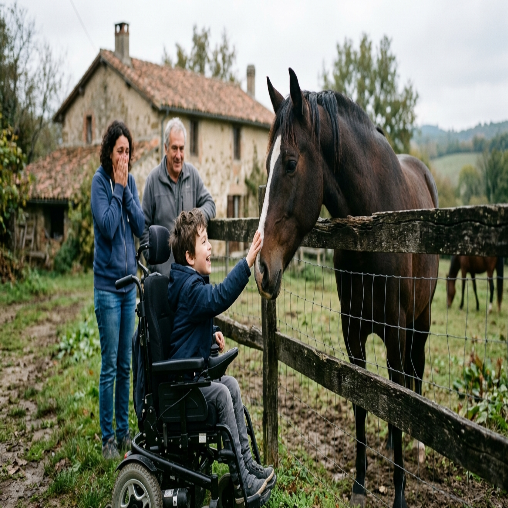
Balthazar reached the fence. Then he stopped dead. He didn’t rear up. He didn’t kick at the boards. He didn’t bare his teeth. He lowered his head. Slowly. As if he was afraid of causing harm. His great muzzle came down to Aubin’s chest. He breathed softly against him, a warm, calm, almost tender breath. I stood frozen.
Aubin raised his hand. A small, pale, weak, trembling hand. He touched the horse’s forehead. And he laughed. Not a polite little laugh to reassure me. A real laugh. A child’s laugh.
I turned around and saw Monsieur Valette near his shelter. He was holding an empty bucket in one hand. He was watching the scene as if the past had just walked up to his door.
An Afternoon Ritual Begins
The next day, at four o’clock, he was there. In front of the fence. With Balthazar. I didn’t feel like going out. I was still scared. But Aubin looked at me with eyes I hadn’t seen in a long time. Eyes that were hoping for something. So I pushed him up to the meadow.
Monsieur Valette didn’t make a big speech. He took an old brush from his pocket and placed it on Aubin’s lap. “Gently,” he said. “He understands calm hands.” Aubin began to brush Balthazar’s neck. The horse didn’t move. For an entire hour.
From that day on, Monsieur Valette and Balthazar came every afternoon at four o’clock. Always. He taught him how to offer an apple in an open palm. Not to make sudden movements. To wait for an animal to give its trust rather than demanding it. Aubin listened to everything. And Balthazar, the horse that everyone feared, would close his eyes as soon as my son placed a hand on him.
There were harder days. Days when Aubin didn’t have enough strength to hold the brush. Then Balthazar would simply bring his big head and rest it, with incredible gentleness, on my son’s knees. Monsieur Valette would stand beside him. Silent. Present. I never asked him why. Perhaps because in France, in our villages, we often respect other people’s silences. We guess that there is pain behind certain doors, but we don’t always dare to knock.
Then one day, after a heavy hospital appointment, Aubin fell asleep in the living room. Monsieur Valette was still outside. I invited him in for a coffee. He sat at my table, both hands around his cup. I asked him gently: “Why are you doing all this for my son?” He looked down for a long time. Then he said: “Because Balthazar recognised him.”
The Story Behind the Silence
I didn’t understand. So Monsieur Valette told me about his grandson. A boy almost the same age as Aubin. The same illness. The same wheelchair. The same arms that were too thin. The same breath that was sometimes too short. Balthazar had been bought for him. Monsieur Valette had been preparing him for months. He had even had a special saddle adapted, so that his grandson could ride his horse at least once. But the child left before. Before the saddle. Before the ride. Before that small happiness they had both been waiting for.
After that, Balthazar changed. He no longer wanted anyone near him. He would kick, refuse food, stand by the gate for hours. “People thought he had become mean,” murmured Monsieur Valette. “I think his heart was just broken. Like mine.” I found nothing to say. He wiped his eyes with the back of his sleeve. “When he saw Aubin, he saw the wheelchair. He smelled the medication. He recognised those fragile gestures. Maybe he thought his little one had come back.”
That day, I understood something. My son had not only been saved by that horse. He was also saving Monsieur Valette. He was also saving Balthazar. Not with strength. Not with words. Just by being there.
For Aubin’s fifteenth birthday, Monsieur Valette brought out the saddle that had stayed too long at the back of the shelter. We helped my son get settled. His hands were trembling, but his face was radiant. Balthazar took a step. Then another. Slowly. With a moving attentiveness, as if he were carrying something precious. I was crying against the fence. Not because my son was ill. But because, for the first time in a long time, he didn’t look like a child who had to be protected from everything. He simply looked like a boy who was living.
When the Village Began to Notice
After that first ride with Balthazar, I thought we had already received our miracle. I was wrong. This horse wasn’t just entering my son’s life. He was slowly changing the whole village.
Gradually, the people in the village began to notice. First the baker’s wife. She would walk past our house on her way home and always slow down a little. One day, she left a small bag on the low wall. Inside, there were some pieces of stale bread. “For the big gentleman in black,” she had written on a piece of paper. Aubin laughed. Monsieur Valette pretended to grumble. “Your horse is going to become spoiled.” But he slipped the bread into his pocket.
Then there was the postman, who would sometimes stop for an extra minute. A neighbour brought apples from her garden. An old carpenter from the village offered to repair a plank on the fence. No one made grand speeches. Here, we don’t always like grand displays. You leave a bag of apples. You hold a gate. You bring a chair. And it means: I am here.
One Wednesday, Aubin asked if he could invite two children from his class. My heart sank a little. I was afraid they would say no. I was afraid they would come out of curiosity, like coming to see something strange. I was afraid Aubin would be disappointed. But he insisted. So I wrote to the parents.
The following Wednesday, two children arrived. A brown-haired girl, Manon, with round glasses. And a very thin boy, Baptiste, who kept tugging at the sleeves of his jumper. They were intimidated. Not by the wheelchair. By Balthazar. Aubin, for his part, looked like a king. He explained to them how to approach their hand. How to stay calm. How to wait for Balthazar to decide. “You can’t just take his trust,” he told them. “You have to let it come.” Monsieur Valette turned his head towards me. His eyes were bright. He didn’t say anything. But I understood that he had just heard his own grief transformed into a gentle lesson in my son’s voice.
The children came back the following week. Then two more. Then another. One afternoon, I saw six schoolbags propped against our wall. Six children sitting in the grass. All silent in front of an enormous horse that had once frightened everyone. Aubin couldn’t run with them. He couldn’t play ball. He couldn’t climb trees. But there, next to Balthazar, he was no longer the child who was set aside because it was complicated. He was the one who knew. The one who showed. The one they listened to.
One evening, after the children had left, Aubin said to me: “Can you believe it, Mum? They come to my house now.” That sentence broke my heart and repaired it at the same time.
Winter, and a Lesson in Loyalty
Monsieur Valette was changing too. At first, he would stay stiff, a little to the side. He would give the instructions, then fall silent. But as the weeks went by, something opened up. He began to tell little things. Not everything. Never everything at once. He would talk about his grandson without saying his name at first. Then one day, he said it. Émile. Aubin repeated softly: “Émile.” As if that name deserved to be set down with care. Monsieur Valette closed his eyes for a second. After that, he spoke of him more often.
Émile loved strawberries. Émile hated being told he was brave. Émile wanted to ride with a red helmet. Émile called Balthazar “my maned truck”. Aubin loved that expression. He repeated it for days. And Monsieur Valette would laugh. Not loudly. Not for long. But he would laugh.
I think that’s when the village really understood. Balthazar had never been mean. Monsieur Valette had never been cold. They had just kept living with an absence too heavy for their shoulders.
Then winter arrived. A real Perche winter. Not spectacular, but damp, penetrating, the kind that gets into your sleeves and into your bones. Aubin went out less. His muscles tired more quickly. Sometimes he would fall asleep after lunch and wake up already exhausted. I was afraid. I knew that fear. It had lived in a corner of my chest for years. It didn’t always shout. But it was always there.
One evening in January, Monsieur Valette knocked on our door. He had never come this late. His face was closed. Balthazar had been refusing to eat since morning. The local vet had been round. Nothing serious, apparently. But the horse stayed at the back of the shelter, head down. Monsieur Valette had that expression I had seen on him before. That of a man who always expects to lose what he loves.
Aubin heard from the living room. “I want to go.” I said no. It was cold. He was tired. Night was falling. He looked at me without crying. “Mum, when I’m not well, he comes.” So we took the warmest blanket. Monsieur Valette wheeled the chair to the shelter with a lantern in his hand. I followed behind, my heart tight.
Balthazar was standing in the straw. Still. His great body suddenly seemed older. Aubin approached. He didn’t speak at first. He just reached out his hand. Balthazar didn’t move. Then, slowly, he turned his head. His muzzle came to find my son’s fingers. Aubin whispered: “I’m here, my maned truck.” Monsieur Valette brought a hand to his mouth. Balthazar breathed out. Then he lowered his head onto Aubin’s knees. They stayed like that for a long time. A very long time. After a few minutes, the horse took a mouthful of hay. Just one. Then another. No one applauded. No one spoke. But in that cold shelter, with the smell of straw and rain, I understood that my son had just given back to Monsieur Valette what he had given him. A reason not to let go.
A Ripple Through the Village
The following spring, something unexpected happened. The headteacher called. She had heard about the Wednesday afternoons with Balthazar. The children were talking about it a lot. Some parents too. She asked if a small visit would be possible — not a big outing, just a simple moment with a few pupils. I was afraid it might become too much. Too many people. Too much noise. Too many expectations for Aubin. But Aubin smiled. “We’ll set some rules,” he said.
He made a list with Monsieur Valette. No running. No shouting. No pointing fingers. No touching without waiting. Respect the animal. Respect each other. On the day of the visit, there were twelve children. No more. Aubin was installed near the fence, with his blanket over his legs and a cap that was too big on his head. Monsieur Valette held Balthazar. I kept some hot tea in a flask.
At first, the children whispered. Then Aubin spoke. His voice was weak. But everyone fell silent. He told them that Balthazar had been afraid of losing someone else. He didn’t talk about illness directly. He only said: “When someone or an animal is scared, it’s no use forcing things. You just have to stay there. Sometimes, just staying there is already a lot.” The headteacher looked down. Monsieur Valette stared at the ground. I was trying not to cry in front of everyone.
After the visit, a little girl came up to Aubin. She had barely said a word all afternoon. She whispered to him: “I get scared in class sometimes too.” Aubin replied: “Then you can come next Wednesday. Balthazar quite likes people who aren’t too loud.”
That day, something began. Not an association. Not some big official story. Just a simple arrangement. On Wednesdays, after school, a few children would come. Not all at once. Those who needed a quiet place. Those who didn’t talk much. Those who were too restless, too lonely, too shy, too sad. Monsieur Valette would say we weren’t going to turn his meadow into a fair. But he would always prepare the headcollar. He would sweep the shelter. He would put aside the least bruised apples. And he would ask Aubin: “Boss, how many visitors are we having today?” Aubin would answer seriously. “Three. No more. Balthazar is entitled to his peace and quiet.” He had become the boss of something. Not in spite of his wheelchair. With his wheelchair. With his slowness. With his way of seeing what others didn’t see.
Our Shared Joy
The summer of his sixteenth birthday, the village organised a little party in the communal field. Nothing grand. Folding tables. Mismatched tablecloths. Homemade tarts. Children running everywhere. Usually, that kind of day made me feel sad. Because I could see everything that Aubin couldn’t do. This time, it was different. When we arrived, the children shouted his name. Not with pity. With joy. Manon pushed his chair to the shade. Baptiste brought him a glass of water. A little boy asked him if Balthazar was coming. Aubin put on an important air. “He doesn’t move for just anyone.” Ten minutes later, Monsieur Valette appeared at the end of the path with Balthazar.
The whole village paused for a second. This was no longer the dangerous horse from half-true stories. This was Balthazar. The big one. The gentle one. The one who had taught the children to lower their voices. The one who had brought a smile back to an old man’s face. The one who had given my son a place that no one else knew how to make for him.
Monsieur Valette came over to us. He had put on a clean shirt. His white hair was combed crookedly. He was holding something under his arm. A small wooden board. On it, he had carved by hand: At four o’clock, we learn to love gently.
Aubin ran his fingers over the letters. He didn’t say anything at first. Then he asked: “Where do we put it?” Monsieur Valette replied: “On the fence. Where it all began.”
That evening, when everyone had gone, the four of us stayed in front of the board. Monsieur Valette. Balthazar. Aubin. Me. The sun was setting behind the hedges. There was that golden light that makes simple things feel almost sacred. Aubin raised his hand towards Balthazar. The horse brought his muzzle closer. My son murmured: “You know, Mum, before, I thought I was the one who always had to be helped. Now I think I can help too.” I replied: “You always did. Others just took longer to see it.”
Where We Are Now
Today, Aubin is seventeen. The illness is still there. It hasn’t disappeared. It hasn’t given us any magical respite. There are still hospital appointments. Nights when I don’t sleep well. Mornings when Aubin doesn’t have the strength to smile. But there is also four o’clock. There is the fence. There is Monsieur Valette coming into our house without knocking when he has made too much soup. There is Balthazar, who knows the sound of the wheelchair before the door even opens. There are children who have become teenagers and who still pass by sometimes, just to place a hand on a great black neck.
And there is my son. My Aubin. Not just fragile. Not just ill. Not just different. A boy who taught a whole village that you can be weak in body and immense in what you give.
I don’t know what the years ahead hold for us. No one really does. But I do know one thing. The day I thought I saw danger charging towards my son, it might have been life coming to him. In the form of an old black horse. With scars on his neck. A broken heart. And enough gentleness to mend our own.