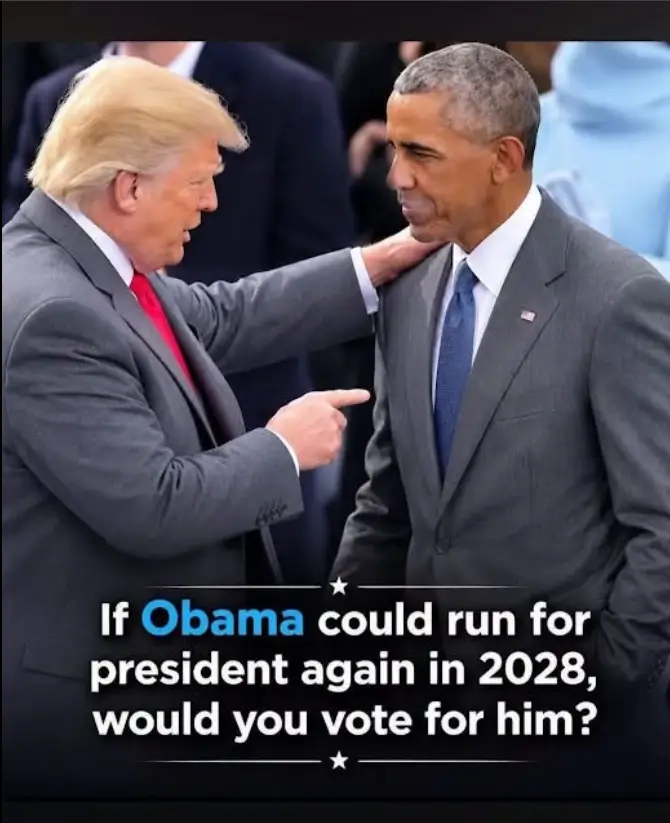
Could Barack Obama Legally Run for President Again in 2028?
Few constitutional questions generate as much debate as whether former President Barack Obama could legally return to the White House. Every election cycle, discussions about former presidents resurface, and because Obama remains one of the Democratic Party’s most influential figures, many people wonder whether he could appear on the presidential ballot again in 2028.
The short answer, according to the overwhelming majority of constitutional scholars, is no. However, some legal commentators have discussed theoretical constitutional loopholes that continue to fuel online debate. Here’s what the U.S. Constitution actually says and why the question continues to attract attention.
Why the Question Keeps Coming Up
Barack Obama continues to play a prominent role in American politics. Although he left office in January 2017, he remains an influential public figure who frequently campaigns for Democratic candidates, delivers speeches, raises campaign funds, and shapes public discussion on national issues.
Because of his continued popularity, many Americans regularly ask:
- Could Barack Obama run for president again?
- Does the Constitution contain a loophole?
- Could the Supreme Court interpret the law differently?
- Could he become president through another constitutional process?
These questions become especially common whenever discussions turn toward future presidential elections.
What the 22nd Amendment Says
The primary constitutional rule governing presidential term limits is the 22nd Amendment, which was ratified in 1951 following Franklin D. Roosevelt’s unprecedented four presidential elections.
The amendment states:
“No person shall be elected to the office of the President more than twice.”
Barack Obama was elected president in:
- 2008
- 2012
Under the plain wording of the amendment, he has already been elected twice, meaning he cannot be elected a third time.
For most constitutional scholars, this ends the legal discussion.
Why Some People Believe There Is a Loophole
The debate exists because the amendment specifically uses the word “elected” rather than “serve.”
Some legal commentators argue that while the Constitution clearly prevents someone from being elected more than twice, it does not explicitly prohibit someone from becoming president through another constitutional mechanism.
This interpretation has led to academic discussion, although it remains highly controversial and has never been tested in court.
The Vice President Theory
The most commonly discussed hypothetical involves the vice presidency.
Under this theory, a presidential candidate could choose Barack Obama as a running mate. If that ticket won the election and the president later resigned, died, or became unable to serve, Obama would theoretically succeed to the presidency.
Supporters of this theory argue that the 22nd Amendment only limits election to the presidency, not succession.
However, another constitutional provision complicates this argument.
The 12th Amendment Creates Another Challenge
The 12th Amendment states:
“No person constitutionally ineligible to the office of President shall be eligible to that of Vice-President.”
This raises an important constitutional question:
If a two-term president cannot be elected president again, does that also make that person constitutionally ineligible to serve as vice president?
Most constitutional scholars believe the answer is yes, although some legal experts disagree. Because no former two-term president has ever attempted this route, there is currently no Supreme Court ruling directly resolving the issue.
What Constitutional Scholars Generally Believe
The overwhelming majority of constitutional experts conclude that a president elected twice cannot legally return to the presidency.
Their reasoning includes:
- The 22nd Amendment was intended to establish a firm two-term limit.
- Allowing a return through the vice presidency would undermine that purpose.
- Constitutional provisions are generally interpreted according to both their language and their historical intent.
For these reasons, most scholars believe that any attempt to bypass the amendment would face immediate legal challenges.
Why the 22nd Amendment Was Adopted
For nearly 150 years, presidents voluntarily followed the tradition established by George Washington of serving no more than two terms.
That tradition ended when Franklin D. Roosevelt won four presidential elections:
- 1932
- 1936
- 1940
- 1944
Following Roosevelt’s presidency, Congress proposed the 22nd Amendment, and it was ratified by the states in 1951 to prevent future presidents from serving extended periods in office.
Could the Constitution Be Changed?
Yes—but changing the Constitution is intentionally difficult.
A constitutional amendment requires:
- Approval by two-thirds of both the House of Representatives and the Senate.
- Ratification by three-fourths of the states.
Although proposals to repeal presidential term limits have occasionally been introduced, none has gained significant support.
Obama’s Continuing Political Influence
Even though he is generally considered ineligible to run again, Barack Obama continues to influence American politics in several ways.
- Campaigning for Democratic candidates
- Delivering speeches
- Fundraising
- Supporting party initiatives
- Issuing endorsements that receive national attention
His role remains significant despite not holding elected office.
Could the Supreme Court Decide?
If a former two-term president attempted to run again, legal challenges would almost certainly begin immediately.
Election officials would likely face lawsuits regarding ballot eligibility, and federal courts would be asked to interpret the Constitution.
Ultimately, the U.S. Supreme Court could become responsible for deciding the issue.
However, because no former president has attempted such a campaign, there is currently no Supreme Court precedent directly addressing this specific constitutional question.
The Role of Public Opinion
Even if a constitutional pathway somehow existed, winning the presidency would still depend on many political factors, including:
- The economy
- National security
- Party unity
- Candidate popularity
- Campaign organization
- Voter turnout
Legal eligibility is only one part of a successful presidential campaign.
Why the Debate Continues Online
Questions about constitutional eligibility often spread quickly on social media because they encourage speculation and debate.
Headlines such as:
- “Could Obama Run Again?”
- “Is There a Constitutional Loophole?”
often generate significant engagement. However, short social media posts rarely capture the complexity of constitutional law, which explains why legal experts continue to debate certain theoretical scenarios.
Historical Importance of Presidential Term Limits
Presidential term limits remain one of the structural safeguards built into the American constitutional system.
Supporters argue they help promote:
- Regular leadership transitions
- Political competition
- Democratic accountability
- Limits on executive power
These principles are intended to strengthen constitutional government regardless of which political party holds the presidency.
Frequently Asked Questions
Can Barack Obama legally run for president again in 2028?
Under the prevailing interpretation of the 22nd Amendment, no. Because he has already been elected president twice, most constitutional scholars conclude he cannot be elected again.
Is there a constitutional loophole?
Some commentators have proposed theoretical loopholes involving the vice presidency, but these remain speculative and are widely disputed.
Has the Supreme Court ruled on this issue?
No. Because no former two-term president has attempted to run again, the Supreme Court has never directly ruled on this specific constitutional question.
Could Congress simply remove presidential term limits?
Only through the constitutional amendment process, which requires approval by two-thirds of Congress and ratification by three-fourths of the states.
Final Thoughts
Based on the widely accepted interpretation of the U.S. Constitution, Barack Obama cannot legally be elected president for a third term because he has already been elected twice. Although legal scholars have debated theoretical constitutional scenarios involving the vice presidency and the wording of the 22nd Amendment, those arguments remain speculative and untested.
If such an unprecedented situation ever arose, the federal courts—and ultimately the U.S. Supreme Court—would likely determine the constitutional outcome. Until then, the prevailing legal consensus remains that the presidency is limited to two elections for any individual.