The Wedding They Tried to Hold on My Land
“Don’t come to the wedding, Mom.”
My only son said it while I stood in my bedroom holding the pale blue dress I had spent three weeks choosing.
The dress was still draped across my arms when Kevin explained that his fiancée believed I would look out of place among her guests. Her relatives and family friends were flying in from New York, Boston, and Chicago. They expected elegance, polished conversation, and people who understood the right clothes for a formal vineyard ceremony.
According to Kayla, I smelled like soil and crushed leaves after thirty years of working the land.
According to my son, my presence would make his wedding more difficult than it needed to be.
Outside my bedroom window, morning fog rested between the first rows of vines. Thomas and I had planted those rows when Kevin was two, using borrowed equipment and money we could barely afford to risk.
“Did you tell her I own the vineyard?” I asked.
Kevin went silent.
“Did you tell her I raised you here after your father died? That the land she chose for her wedding exists because I spent three decades building it?”
“Mom, please.”
The strain in his voice was unmistakable.
“I just need today to go smoothly.”
I folded the dress once and placed it on the bed.
“Understood.”
Then I ended the call.
My name is Kimberly Vance. I was sixty-five years old that morning, and until my son told me not to attend his wedding, I believed I understood the difference between being taken for granted and being deliberately removed.
I did not cry.
I did not throw the phone or call him back.
I stood beside the bed with both hands resting on the blue fabric and listened to the old house settle around me.
The ceremony was scheduled for four that afternoon at Vance Coastal Vineyards, the property I had legally owned since Thomas and I purchased it three decades earlier.
The tasting barn had been transformed into a reception hall. White roses were arriving from San Francisco. Four hundred chairs had been rented. A catering team was preparing dinner for guests who, according to Kayla, mattered more than the woman whose name appeared on the gate.
The rehearsal dinner had been held at a hotel the night before. Kevin called that morning because he knew I planned to arrive early and help.
I had spent the previous week checking the guest cottages, reviewing vendor access, and approving the use of the southern lawn. I had personally paid for upgrades to the electrical system so the reception lighting would not overload the old circuits.
Kayla accepted every improvement without once asking who authorised it.
Now I had been told not to come.
The doorbell rang while I was still standing beside the dress.
I did not move.
It rang again.
On the third ring, I walked downstairs, smoothed the front of my blouse, and opened the door.
Kenneth Harrison stood on the porch carrying a leather briefcase.
Kenneth had been our family attorney for twenty-five years. He drew up Thomas’s will, helped reorganise the vineyard after the financial downturn, and sat beside me in a hospital waiting room on the night my husband did not come home from a highway accident.
He had an expression reserved for days when the truth would not become kinder simply because someone delivered it gently.
“You didn’t call,” I said.
“I didn’t think this belonged on the phone.”
I stepped aside.
Every serious conversation in our home had taken place at the kitchen table. Thomas used to say the vineyard visible through the windows kept people honest.
I poured two cups of coffee.
Kenneth placed his briefcase on the table but did not open it.
“How much do you already know?”
“Kevin called.”
Kenneth waited.
“Kayla doesn’t want me at the wedding. She thinks I will embarrass her.”
“Kim.”
“Don’t apologise for him.”
“I wasn’t going to.”
The answer stopped me.
“Then why are you here?”
He opened the briefcase and removed a thick folder.
“Three days ago, Rosa found an email in the company inbox.”
Rosa Mendez had managed Vance Coastal for fifteen years. Nothing crossed the general business account without her seeing it.
“What kind of email?”
“One Kayla intended to send elsewhere.”
Kenneth placed a printed page on the table.
Kayla’s name appeared at the top. The intended recipient was Kyle Henderson.
I knew the name immediately.
Henderson owned a large development and hospitality company that had tried twice to purchase our vineyard. Thomas rejected him the first time. I rejected him the second.
He did not want only the land. He wanted the Vance label, the distribution contracts, the tasting club, and the view of the coast that no architect could reproduce.
“Why did it come to us?” I asked.
“Kayla had previously copied the vineyard on a vendor discussion. When she selected the address, she chose our general account instead of Henderson’s private one. Similar labels in her contacts. One careless selection.”
“No one accessed her private account?”
“No. She sent it to us.”
I began reading.
Kenneth had highlighted several sections.
The first said that Kevin would sign whatever Kayla placed before him after the wedding. It described me as the only remaining obstacle.
The second referred to the vineyard transfer occurring within sixty days of the ceremony.
The third explained the real plan.
Once Kayla and Kevin controlled the land, Henderson Estates would acquire the property, absorb the Vance Coastal label, and replace our family name within eighteen months.
At the bottom of the email, Kayla wrote:
Kevin thinks this is about expanding the tasting business. He does not need to understand the full structure until everything is signed.
I put the page down.
For a few seconds, the kitchen contained only the small sound of the refrigerator motor and wind touching the vines outside.
“She isn’t marrying my son,” I said.
Kenneth removed his glasses.
“She appears to view the marriage as part of a business transaction.”
The sentence was precise.
That made it worse.
I looked through the window toward the western block, where Thomas and I had planted our first Cabernet vines.
Three decades of work stood in orderly rows under the morning fog.
Kayla believed she could marry Kevin, obtain the land, transfer it to Henderson, and erase our name from the bottles before the vines completed two more harvests.
“How does she believe she owns it?”
Kenneth removed a second document.
Three weeks earlier, Kevin and Kayla had met me in his office to discuss what they called a wedding gift.
I had agreed in principle to place the vineyard into a family trust benefiting Kevin after my lifetime. Kayla presented the idea as continuity. Kevin held my hands and told me the land would remain in the family forever.
I signed an initial declaration allowing Kenneth to begin drafting.
I believed the final structure would preserve my control while creating a clear succession plan.
Kayla apparently believed I had signed away the property.
“You did not complete the transfer,” Kenneth said.
“I signed the declaration.”
“That authorised preparation. It did not change ownership.”
He turned to the final pages.
“The property is held through your revocable trust. Any transfer requires a second authorisation, updated valuation, and final filing with the county recorder. That confirmation was scheduled for next Tuesday.”
“After the honeymoon.”
“Yes.”
“So every acre still belongs to me.”
“Legally and completely.”
I placed both hands flat on the table.
Fourteen million dollars in land, equipment, buildings, inventory, trademarks, and contracts remained under my control because one final document had not been filed.
Kayla had planned an acquisition around property she did not own.
“What does Kevin know?”
Kenneth’s face changed.
“There is more.”
He removed bank statements, transfer records, and a financial summary.
The first page carried Kevin’s name.
I recognised the account. Thomas had created it the year Kevin was born. He contributed to it annually until his death. When Kevin turned eighteen, the trust held enough to start a business, purchase land, or build a stable future.
The balance on the statement before me was zero.
“What happened?”
“Kevin moved the funds into a joint account after his engagement.”
“I know that part.”
“Kayla managed the account.”
The withdrawals began fourteen months earlier.
Small transfers at first.
Then larger ones connected to luxury vendors, private travel, speculative investments, and payments routed through companies linked to Henderson.
Kevin had also accumulated significant private debt while attempting to keep pace with a lifestyle he could not afford.
The total obligation was nearly three hundred eighty thousand dollars.
I stared at the number.
“He never told me.”
“He may have been ashamed.”
“Or he expected the vineyard to solve it.”
Kenneth did not disagree.
“Henderson purchased several of those obligations from the original lenders eight months ago.”
I looked up.
“He owns Kevin’s debt.”
“He controls it, yes.”
“And Kayla controls Kevin’s finances.”
“Yes.”
The structure became visible.
Henderson had not simply convinced Kayla to sell the vineyard after marriage.
He had spent months creating pressure around Kevin, buying the obligations, and waiting for access to the land.
Kayla was not caught in the plan.
She was helping execute it.
I walked to the sink and ran cold water over my wrists.
Outside, the fog was lifting. Sunlight reached the upper rows first, turning the leaves silver-green.
The vineyard remained calm because land does not know when people are trying to betray it.
I turned off the water.
“Can I close the property today?”
Kenneth answered without hesitation.
“You are the sole owner. You can cancel access, revoke every vendor permission, and close every gate.”
“Even if the wedding is scheduled here?”
“The event agreement is between the vineyard and the couple, but you control the venue. Given the evidence of attempted financial misconduct involving the property, you have clear grounds to suspend the event.”
“What have you already done?”
“I preserved the emails, notified the title company not to accept transfer instructions, and filed for an emergency civil injunction preventing Kayla, Kevin, Henderson, or their representatives from using any existing draft, authorisation, or trust document.”
“Has it been approved?”
“The judge signed it this morning.”
I sat again.
Kenneth opened a final folder.
The order prohibited the sale, transfer, pledge, or use of the vineyard as collateral. It required Kayla and Henderson to preserve communications and financial records. It also directed that the documents be formally served that afternoon.
No one would be arrested at my gate.
No scene required force.
But no transaction could move.
No signature could be used.
No lender could accept the land as security.
The wedding they had designed as the first step toward controlling the property could not legally take place there without my permission.
“When will they be served?”
“Kayla’s legal representative will receive the papers before four. Henderson’s counsel has already been notified.”
“Do they know you have the email?”
“They know a court order exists. They do not yet know every document supporting it.”
I looked at the kitchen clock.
Ten thirty-eight.
The ceremony was less than six hours away.
My phone remained silent on the counter.
Kevin had excluded me from my own land and assumed I would spend the afternoon alone with a blue dress.
The doorbell rang again.
Diana Reeves stood outside holding a casserole covered in foil.
Diana had been my closest friend since the year Thomas and I purchased the property. She once managed the county agricultural extension office and had helped us understand soil conditions, irrigation, and the diseases that could destroy a vineyard before inexperienced owners knew what they were seeing.
She never arrived with empty sympathy.
She brought food and attention.
“I heard from Rosa,” she said. “Not everything. Enough.”
I let her in.
She placed the dish on the kitchen counter, nodded to Kenneth, and waited.
So I told her.
The phone call.
The email.
Henderson.
The unfinished transfer.
Kevin’s debts.
The empty trust account.
The injunction.
Diana listened without interrupting.
When I finished, she folded both hands on the table.
“Are you considering pretending none of this happened?”
The question entered a place I had been avoiding.
“I don’t know.”
“You do know.”
“I don’t want to destroy my son’s wedding.”
“Kayla planned to use the wedding to take his inheritance and your land.”
“He may not know.”
“Then he needs to know.”
“He told me not to come.”
Diana’s eyes softened, but her voice did not.
“Kim, if you stay quiet today, Kevin will spend the rest of his life believing this was acceptable. He will believe you can be dismissed, embarrassed, and removed from your own land, and you will still hand him the deed afterward.”
I looked toward the window.
Thomas’s photograph rested on the shelf near the kitchen door. He stood beside the first small harvest, grinning beneath a sun-faded hat.
“Thomas did not build this so someone could turn your son’s marriage into a property closing,” Diana said.
Something inside me settled.
Not anger.
Decision.
I turned to Kenneth.
“Proceed.”
He made one brief phone call to confirm the injunction would be served according to plan.
Then I called Rosa.
She answered immediately.
“Mrs. Vance.”
“It’s time. Close the gates.”
A small pause.
“Yes, ma’am.”
No surprise.
Rosa had known enough to prepare.
I walked onto the back porch with cold coffee in my hand. Diana stood beside me while Kenneth remained inside organising documents.
Across the property, Rosa moved with the same deliberate efficiency she used during harvest.
She closed the north service gate first.
The steel frame rolled along its track and met the post with a final mechanical sound.
She tested the lock.
Then she drove to the equipment entrance.
Rosa knew every gate, irrigation valve, storage building, and fence sensor on the property. She had worked through droughts, smoke seasons, labour shortages, and the year a storm ruined half the early crop.
Kayla had visited the vineyard dozens of times.
She had never learned Rosa’s last name.
By noon, the security team stood at each entrance with written instructions. They were visible and calm. No one was to argue with guests or vendors. Anyone arriving would be informed that the private event had been suspended and that the property was closed.
The main gate remained open until one thirty so regular morning workers could leave.
Rosa stopped beneath the wooden VANCE COASTAL VINEYARDS sign Thomas and I had installed after our first profitable season.
She looked toward the porch.
Across the distance, our eyes met.
She gave one deliberate nod.
I returned it.
The gate swung shut.
My phone began vibrating ten minutes later.
The first text came from the wedding planner.
The catering team says vineyard access has been suspended. Please confirm immediately.
The second came from an unknown number.
Florist cannot enter. We need someone at the gate.
Then Kevin called.
I watched his name appear and let it ring.
He called again.
Mom, please answer. Something is wrong.
I placed the phone face down.
At two fifteen, the first catering truck arrived.
The driver pressed the intercom twice. A security employee walked to the window, handed him a printed notice, and directed him toward the highway.
The truck waited nearly two minutes.
Then it reversed.
The florist came next.
Then the sound-equipment company.
A flatbed carrying reception tables reached the service entrance and found it locked.
By three thirty, vehicles lined both sides of the road.
Private cars and hired sedans joined the vendors. Guests in formal clothing stepped out beneath the afternoon sun and stared at their phones.
The scene was not satisfying.
I felt no joy watching people who knew nothing about the plan become confused.
They had expected a wedding.
Most were innocent.
That made the choices of the people who created the situation even more careless.
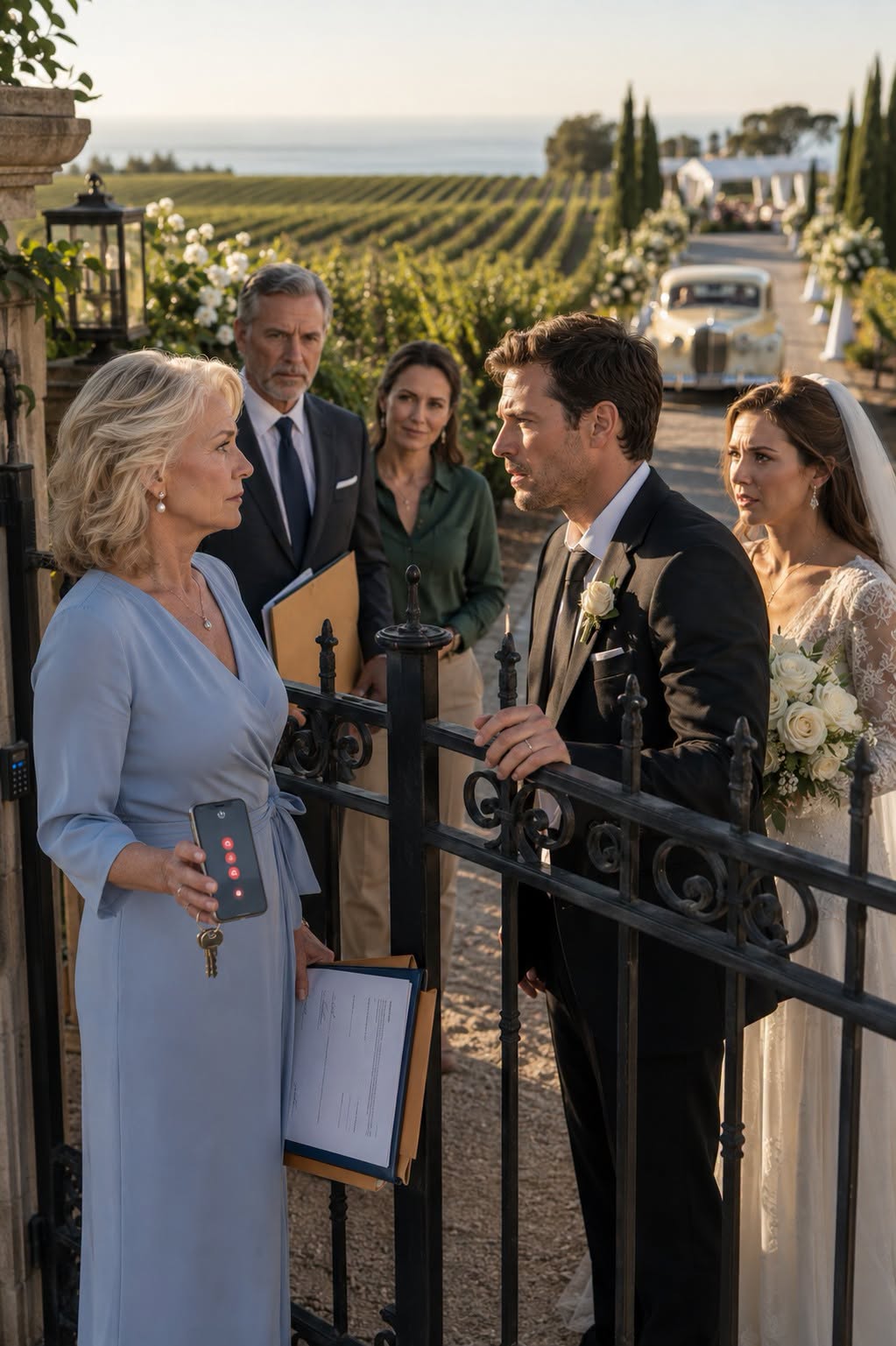
At three forty-two, a cream-coloured vintage car stopped outside the main entrance. White ribbons were tied to its door handles. Garden roses rested across the hood.
The rear door opened.
Kayla stepped out wearing an ivory silk gown with long lace sleeves. Her veil caught the sunlight. Her hair, makeup, and posture had been assembled for photographs.
She looked at the locked gate.
Then at the vineyard sign.
Then at the security guard approaching her with a sealed legal envelope.
Confidence did not leave her face immediately.
First came annoyance.
Then disbelief.
Finally, calculation.
She accepted the envelope but did not open it until the guard stepped away.
When she read the first page, her body became still.
She called someone.
I knew who before Kyle Henderson’s vehicles arrived twelve minutes later.
Three black SUVs turned from the highway and stopped near the gate. Henderson stepped from the middle one wearing a dark suit without a tie.
He was a broad man in his late fifties, silver-haired, composed, and accustomed to rooms adjusting around his expectations.
He looked at the gate.
Then at the Vance sign.
Finally, he looked toward the house.
He saw me standing at the upstairs window.
Henderson raised one hand, not quite waving.
Summoning.
I walked downstairs.
Kenneth stood near the kitchen door.
“I’ll remain on the porch.”
I crossed the yard and stopped on my side of the iron gate.
Henderson remained on his.
Six feet of metal and thirty years of work separated us.
“Kimberly,” he said warmly. “There has been a misunderstanding.”
“No.”
His smile remained in place.
“Open the gate so we can discuss this privately.”
“We are discussing it.”
“There are hundreds of guests on the road.”
“They are free to leave.”
“This is your son’s wedding.”
“It was scheduled on my property.”
Henderson stepped closer.
“Whatever issue you have with Kayla can be addressed after the ceremony.”
“The court order says otherwise.”
His expression flattened.
“You moved quickly.”
“You moved first.”
He lowered his voice.
“I control nearly four hundred thousand dollars of Kevin’s obligations.”
“I know.”
“If those obligations become publicly disputed, your son’s financial future could become extremely difficult.”
“Then Kevin will need qualified advice and a repayment plan.”
“You can solve the problem today.”
“By giving you the vineyard.”
“By honouring the transfer you already agreed to.”
“There was no completed transfer.”
His eyes sharpened.
“You signed.”
“I authorised drafting. I did not transfer title.”
“You intended to.”
“I intended to protect my family. Your emails clarified what protection requires.”
For the first time, Henderson looked toward Kayla.
She stood near the cream-coloured car, holding the injunction. Her veil moved in the wind.
He looked back at me.
“Open the gate.”
“No.”
“Kimberly, think carefully.”
“I have.”
He placed one hand on the iron.
“This will have consequences for Kevin.”
“So did hiding the truth from me.”
“Is a wedding worth your son’s future?”
I held his gaze.
“My son’s obligations are his to resolve. My land is not your collection account.”
Henderson’s jaw tightened.
“You are making an emotional decision.”
“No. I am reading the paperwork.”
The sentence struck deeper than anger would have.
I turned away.
“Kimberly.”
He raised his voice behind me.
“I am not finished.”
I kept walking.
“I am.”
Before I reached the porch, Kenneth stepped forward.
“Henderson’s attorney just called. The asset-preservation order has been received. They cannot use Kevin’s debt as leverage in any transaction involving the vineyard while the civil review is pending.”
I looked back.
One of Henderson’s associates had approached him with a phone. The man spoke rapidly.
Henderson went quiet.
Then he turned toward Kayla.
Whatever arrangement they had believed was ready to close had stopped.
His three SUVs left six minutes later.
Kayla remained.
The guests had begun gathering in uncertain groups along the road. Her wedding planner stood beside her with a tablet. Her driver remained near the car.
Kevin appeared from between two parked vehicles.
He wore a black wedding suit, though his jacket was missing and his tie hung loose. His hair was disordered from repeatedly running his hands through it.
He saw Kayla holding the legal papers.
Then he saw Henderson’s cars leave.
Finally, he looked toward the house.
He walked through the pedestrian access point after security received my permission.
I opened the front door before he knocked.
“Mom.”
His voice broke.
He looked thirty years old and fourteen at the same time.
“What did you do?”
“I protected the property.”
“You stopped the wedding.”
“The wedding was built around a plan you did not understand.”
“Kayla says this is a misunderstanding.”
“Come inside.”
He followed me into the kitchen.
The same kitchen where he had eaten thousands of breakfasts, finished homework, and learned to crack eggs one-handed because Thomas believed every child should master one unnecessary skill.
Kevin looked around as though the room had changed.
“Fix it,” he said.
“I cannot.”
“You can open the gate.”
“Yes.”
“Then do it.”
“No.”
His face twisted.
“Mom, she’s standing out there in her wedding dress.”
“She also arranged to transfer this vineyard to Kyle Henderson.”
Kevin stared at me.
“That’s not true.”
Kenneth entered from the porch and placed the email on the table.
Kevin did not touch it.
“Read it,” I said.
He looked from the page to me.
“This is private.”
“It was sent to the vineyard.”
“She wouldn’t—”
“Read it.”
His hands shook as he picked up the first sheet.
The room became silent except for the pages moving between his fingers.
He read the part about controlling him after the wedding.
He read the sixty-day transfer schedule.
He read the plan to remove the Vance name.
His face emptied.
“She said Henderson was an investor.”
“He was purchasing access.”
Kevin placed the email down.
“She loves me.”
“I cannot answer that for you.”
“You did this because she didn’t want you here.”
“I closed the property because she planned to take it.”
His eyes filled.
“You could have told me.”
“This morning, you told me not to come.”
The words stopped him.
He looked at the pale blue dress visible through the open doorway upstairs, still resting on my bed.
For several seconds, neither of us spoke.
Then Kevin said, “She knew you would make things difficult.”
“By reading documents?”
“You never trusted her.”
“I was preparing to give both of you fourteen million dollars in property.”
His mouth closed.
I stepped closer.
“I need to ask you one question.”
He wiped his face.
“What?”
“Do you need me, Kevin?”
His eyes moved toward the window.
“Or do you need the vineyard?”
The kitchen became completely still.
Five seconds passed.
Then ten.
Kevin searched my face for a way around the question.
He did not answer.
That silence hurt more than the phone call.
I took out my phone and called Kenneth’s office line, though he stood only a few feet away.
“Freeze every inheritance provision,” I said.
Kenneth nodded.
“Effective immediately.”
I ended the call.
Kevin’s shoulders folded.
“Mom.”
“I love you.”
He began crying.
“That is why I will not give you an asset large enough to prevent you from understanding your own life.”
He covered his face.
I placed both hands on his shoulders.
“Come with me.”
The oldest vine on the property grew in the northeast corner, separated from the commercial rows.
It had already been mature when Thomas and I purchased the land. Its trunk was thick, twisted, and grey with age. Thomas used to sit beneath it on Sunday mornings with coffee and a newspaper.
Kevin had not visited that part of the vineyard in years.
He followed me silently.
At the base of the old vine, a flat stone covered a shallow hollow in the soil.
I lifted it and removed a cedar box Thomas had made.
Kevin stared.
“What is that?”
“Something your father left for you.”
Inside was a letter, a family photograph, and a bank statement.
I gave him the statement first.
The trust Thomas created for Kevin had once held four hundred twenty thousand dollars.
The current balance was zero.
Kevin looked at the bottom of the page.
“This is wrong.”
“No.”
“Where did it go?”
“When you opened the joint account with Kayla, the trust funds moved into it.”
“I know.”
“She had full access.”
Kevin turned the page over.
“Small transfers began fourteen months ago. Larger withdrawals followed.”
“No.”
“Some paid vendors. Some moved through companies tied to Henderson. Some covered debts you never told me about.”
“She said she was investing it.”
“She was positioning both of you for this transaction.”
Kevin sank onto an old wooden bench beneath the vine.
His hands pressed against his knees.
“She took everything Dad left me.”
“Yes.”
The answer was difficult.
It was also necessary.
“I let her.”
“Yes.”
His voice became thin.
“I told you not to come because she said the guests would judge us.”
“Yes.”
“I let her talk about you like that.”
“Yes.”
He looked up.
“Why aren’t you telling me it’s going to be okay?”
“Because I don’t know what okay looks like yet.”
He bent forward and cried with his face in both hands.
I sat beside him.
For several minutes, I did not touch him.
Then I put one arm around his shoulders.
Comfort does not require dishonesty.
“You are still here,” I said.
“I lost everything.”
“You lost money, trust, and a future you believed existed.”
“That sounds like everything.”
“It is not your ability to become someone different.”
He looked toward the vines.
“I don’t know how.”
“Start by no longer expecting someone else’s land to solve your choices.”
My phone buzzed.
Diana had returned after hearing that several news vehicles had arrived near the main entrance. Rumours were already moving online.
One version said I had become confused and cancelled the wedding without explanation.
Another claimed Kevin had created the financial problem.
Neither was accurate.
I left Kevin beneath the vine and walked toward the front gate.
Diana met me halfway.
“Three news vans,” she said. “A local newspaper photographer. People are inventing the story faster than facts can travel.”
I looked at the vendor trucks waiting farther down the road.
The food had been prepared.
The flowers were beautiful.
Hundreds of people had driven long distances.
Most had done nothing wrong.
Then I thought about the families in town who rarely visited the vineyard because formal events were too expensive.
I called Rosa.
“Is Martinez Catering still available?”
“They’ve been waiting.”
“The Ortega family band?”
“Also waiting.”
“Open the side gate.”
“For whom?”
“Everyone.”
At the main entrance, cameras turned toward me.
A reporter stepped forward.
“Mrs. Vance, can you explain why the wedding was cancelled?”
“The planned ceremony has been postponed due to a private legal matter.”
“Can you comment on the dispute involving the vineyard?”
“No.”
I looked toward the road.
“The food is prepared, the musicians are here, and the property is ready for guests. Vance Coastal Vineyards will host a free community harvest dinner this evening. Local families are welcome.”
The reporter blinked.
“Tonight?”
“Yes.”
“What about the wedding flowers?”
“They are beautiful. They should be enjoyed.”
Behind me, the side gate opened.
Martinez Catering drove onto the property.
The Ortega family arrived next with instruments packed inside two vans. Rosa called local schools, farm cooperatives, and family-service groups.
Within an hour, the wedding tables were filled with people who had never expected invitations.
Children ran between the vine rows.
Older couples danced beneath strings of lights.
The white flowers intended to impress Kayla’s guests decorated tables where farmworkers, teachers, shop owners, nurses, and families shared dinner.
Kevin remained near the old vine until sunset.
When he finally walked toward the reception lawn, he stood at the edge watching children dance.
His expression looked like wonder and grief occupying the same face.
The final car left at eight forty-seven.
I knew because I watched a minivan turn toward the highway while a sleeping child rested against her father’s shoulder.
Rosa joined me on the porch with tea.
“Everything is secured,” she said. “I’ll return at six to check irrigation.”
“Thank you.”
“This is my home too.”
Then she collected her keys and walked towards her truck.
The vineyard stretched into the dark, row after row beneath low security lights.
Thomas used to say the land did not panic.
People panicked.
Markets panicked.
Weather changed.
The land waited for whoever showed up willing to work.
“I did what you would have done,” I said quietly.
Wind moved through the leaves.
It sounded almost like applause, though I knew it was only wind.
Three months passed.
The civil case ended through a settlement and court judgment.
Kayla admitted submitting false financial documents, using Kevin’s