the Sunday Call That Went Silent – A Father’s Rescue
At 7:15 on Sunday evening, my daughter’s face still had not appeared on the screen.
For eight years, Clare had called us at seven sharp. Not seven-ten. Not whenever she remembered. Seven.
She would prop her phone against the blue fruit bowl on her kitchen counter, tuck a loose strand of hair behind one ear, and say, “There are my favorite people,” as if Maggie and I had not been waiting beside my phone for the previous five minutes.
Then Gracie would climb into the frame.
Our granddaughter was nine years old and incapable of telling a short story. A spelling quiz required background information about the teacher, three classmates, the pencil she used, and what the cafeteria served for lunch. A book report became a full performance. By the time the call ended, Maggie and I knew everything happening in fourth grade at Pine Ridge Elementary.
That Sunday, the phone remained silent.
The Braves were finishing their final game of the season on television, but I had muted it at seven. Maggie had brought her chair closer to my recliner, still wearing the flour-dusted apron she used while baking.
The house smelled like pot roast, rosemary, and the lemon pound cake cooling on the kitchen island.
At 7:05, Maggie smoothed her apron over her knees.
“She’s probably finishing dinner.”
“Probably.”
At 7:10, she looked at the clock above the fireplace.
“At the fall carnival, Gracie said her class was running the ring-toss booth. Maybe they stayed late cleaning up.”
“The carnival was Friday.”
“I know. I’m just saying there could be school things.”
At 7:15, I called Clare.
It rang four times.
Then her voicemail answered in the bright, familiar voice she used for parents and school administrators.
“Hi, you’ve reached Clare. Leave me a message, and I’ll call you right back.”
“Hey, sweetheart. It’s Dad. Your mother and I are here. Give us a call when you get a chance.”
I ended the call and placed the phone on the coffee table.
Maggie brought two bowls of pot roast from the kitchen. Neither of us ate much.
At 7:30, I called again.
This time, the call went directly to voicemail.
No ringing.
Just silence, followed by Clare’s recorded voice.
Maggie lowered her fork.
“Her phone’s off.”
“Or the battery died.”
“She charges it every afternoon.”
“She could have forgotten.”
Maggie looked at me.
We had been married forty-three years. There were few expressions left on her face that I could not read.
She wanted me to tell her everything was fine.
I wanted to tell her the truth.
“I’ll call Brandon,” I said.
Our son-in-law answered on the second ring.
“Paul.”
The name was delivered smoothly, almost automatically.
I frowned.
“It’s Ray.”
A pause followed.
“Right. Sorry, Ray. What’s going on?”
“We were supposed to video call Clare at seven. She isn’t answering.”
“Oh. Yeah. She went out this afternoon.”
“Where?”
“To see a friend.”
“Which friend?”
Another pause.
“Someone from school. I don’t remember the name.”
I looked at Maggie. She leaned forward, trying to read my face.
“When will she be home?”
“Late, probably. You know how Clare gets when she starts catching up with people.”
I did know Clare.
That was the problem.
She did not disappear for an evening without texting her mother. She did not miss the Sunday call. She did not leave her daughter behind without mentioning it.
“Where’s Gracie?”
“She’s here with me.”
“Put her on.”
“She’s taking a bath.”
“I can wait.”
“No need. I’ll tell Clare to call when she gets back.”
“Brandon—”
He ended the call.
I sat holding the phone while the pot roast cooled in my lap.
Maggie waited.
“He said Clare went to visit a friend.”
“Which one?”
“He didn’t know.”
Her fork went down completely.
“Clare tells us when she buys new curtains. She would have mentioned visiting someone on a Sunday night.”
“I know.”
“And she would not miss Gracie’s call.”
“I know.”
Maggie reached across the space between our chairs and placed one hand over mine.
The television screen showed players leaving the field beneath stadium lights. Without sound, the celebration looked distant and artificial.
In forty years as a plumber, I learned that silence was rarely an absence of information.
A pipe did not stop flowing for no reason.
Something blocked it.
Something broke.
Something changed upstream.
You did not stare at the dry faucet and hope the problem corrected itself. You traced the line back to its source.
“I’ll try again in an hour,” I said. “If she doesn’t answer tonight, I’ll call the school in the morning.”
“And if they don’t know where she is?”
I looked toward the framed photograph above our stove.
Clare was eight years old in the picture, sitting on a stack of PVC pipe in my old work truck. My hard hat covered half her forehead. She smiled so widely her eyes had almost disappeared.
“Then I’m getting in the truck.”
Maggie nodded.
Neither of us touched our dinner again.
By two in the morning, I had left four messages.
I lay in bed staring at the ceiling while Maggie slept with one hand resting on my arm. Her breathing was even, but every so often her fingers tightened against my sleeve.
At 2:14, I eased out from beneath the blanket and went to the kitchen.
The linoleum was cold beneath my socks. I started a pot of regular coffee instead of the decaf Maggie had been buying since my last physical.
My phone sat on the table.
No messages.
No missed calls.
I dialed Clare again and listened to her voicemail all the way to the beep.
This time, I did not speak.
I looked at the photograph above the stove.
When Clare was a child, she came with me on summer jobs. She was too young to help, but she hated being left with babysitters and I rarely had the heart to refuse her.
She sat safely in the truck or on an overturned bucket and asked questions.
Why did upstairs water take longer to get hot?
Why did pipes knock at night?
Why did pressure drop when two faucets ran at once?
I answered every question as if it mattered because, to her, it did.
Once, while listening to a heating pipe expand inside a wall, she said, “The house is talking.”
“Something like that.”
“Do you always understand it?”
“Not always.”
“But you listen.”
“Yes.”
Years later, when she told me she wanted to become a teacher, she said it was because I had made difficult things feel understandable.
“That’s the finest reason I’ve ever heard for choosing a job,” I told her.
Now she was thirty-five, teaching fourth grade, raising a nine-year-old daughter, and married to a man I had never fully trusted.
Brandon Foster sold high-end real estate around Atlanta. He was handsome in a polished way that always felt prepared. Even alone in a room, he seemed to be performing for someone.
He remembered names when they were useful.
He complimented people whose approval mattered.
He had a talent for presenting every decision as the only reasonable one.
Clare loved him.
At least, she had loved him when they married.
Over the previous year, something in her Sunday-call voice had changed.
She still laughed. She still asked about Maggie’s farmers-market sales and whether my knees hurt when it rained. She still listened while Gracie explained school projects.
But beneath the warmth was tension.
Like a supply line carrying too much pressure.
Three months earlier, I had asked her directly.
“You doing okay, sweetheart?”
“I’m fine.”
The answer came too fast.
“Just tired?”
“Long week.”
I did not push.
I told myself she was an adult. I told myself a father had to respect his daughter’s marriage. I told myself concern could become interference if it crossed the wrong line.
The month before, I drove to Marietta to repair a shower fitting Brandon had damaged while trying to install a new fixture.
Clare stood in the bathroom doorway talking to me while I worked. When she reached for a towel, her sleeve shifted and I saw a fading pressure mark around her wrist.
She pulled the sleeve down.
“Caught it on a cabinet.”
I accepted the explanation.
Sitting alone in the kitchen at two in the morning, I understood how badly I wanted that explanation to be true.
Maggie appeared in the doorway wearing her robe.
“Come back to bed.”
“I can’t.”
She sat across from me and took my hand.
“You’re thinking about that mark on her wrist.”
It was not a question.
“I should have asked again.”
“She said it was a cabinet.”
“We both knew that didn’t sound right.”
Maggie’s mouth trembled.
“She’s fine.”
The final word wavered.
We heard it.
At eight the next morning, I called Pine Ridge Elementary.
A receptionist named Carol answered.
“My daughter is Clare Foster,” I said. “She teaches fourth grade. I need to know whether she filed a leave request.”
Keyboard clicks filled the line.
Then silence.
“Mr. Caldwell, Mrs. Foster has been absent since Wednesday.”
My grip tightened around the phone.
“Wednesday?”
“Her class has had a substitute for five days. There’s no leave request, no sick-day form, and no communication from her. The principal has been trying to reach her.”
Maggie pressed both hands flat against the table.
“Did anyone speak to her husband?”
“We left messages.”
“Did he answer?”
“I don’t have that information.”
I thanked Carol and ended the call.
The kitchen became painfully quiet.
“Five days,” Maggie whispered.
I stood.
“I’m going.”
She followed me to the bedroom.
“I’m coming with you.”
“I need you here.”
“Raymond—”
“If Clare calls the house, if the school calls back, if Gracie reaches anyone, you need to answer. You’re my backup.”
Maggie crossed her arms tightly.
“I hate this.”
“I know.”
I pulled on jeans, a flannel shirt, and my old work boots. The boots had spent years in crawl spaces and construction sites. I thought better wearing them.
At the front door, I took my keys from the hook and grabbed the small toolbox I still kept in my truck.
Before backing out, I called Brandon.
He answered on the third ring.
“Paul.”
This time, cold moved through me.
“My name is Raymond.”
Silence.
“You’ve called me Paul twice. Who is Paul?”
“I’m tired, Ray. You’re making too much of this.”
“Clare has missed five days of work. Her school has no leave request. Give me the name of the friend she’s visiting.”
“I already told you—”
“Name.”
“I don’t remember.”
“Phone number.”
“I don’t have it.”
“Address.”
“Ray, calm down.”
“Put Gracie on.”
“She’s not available.”
“Where is my daughter?”
The line went dead.
I sat in the idling truck, staring at the phone.
A man who had known me for ten years had called me the wrong name twice.
People mixed up names when another name occupied the front of their mind.
Paul mattered.
I just did not know how yet.
The drive down I-75 felt four times longer than usual.
I kept the radio off.
Georgia pine trees blurred past the windows, giving way to shopping centres, subdivisions, and morning traffic as I approached Marietta.
I had driven that route for birthdays, Christmas mornings, school concerts, and emergency plumbing repairs.
Never like this.
Every red light felt personal.
I turned onto Birchwood Lane at 9:27.
The neighbourhood was quiet. Ranch houses sat beneath mature oak trees. Yellow leaves covered the sidewalks. Several porches displayed pumpkins and small flags.
Clare’s blue Honda was parked in the driveway.
Brandon had told me she drove out of town.
I stopped across the street and studied the house.
All the curtains were closed.
The porch light remained on despite the morning sun.
Three newspapers lay along the walkway, their plastic sleeves dark with dew.
The flower box beneath the front window held yellow mums Clare watered every morning.
They were wilted.
I crossed the street and knocked.
“Clare?”
Nothing.
I knocked again.
“It’s Dad.”
A dog barked down the block.
No footsteps came from inside.
“Gracie? Grandpa Ray is here.”
Silence.
I walked around to the garage. Through the small window, I saw Clare’s car in the near bay.
The second bay was empty.
Brandon’s black SUV was gone.
Back on the porch, I reached into my pocket.
Two years earlier, after a nearby break-in, Clare quietly gave me a spare key.
“Just in case,” she said.
She had made sure Brandon was in another room when she handed it to me.
At the time, I considered it ordinary caution.
Now the memory felt like a message delayed by two years.
The key turned.
Stale air met me when I opened the door.
The house looked normal at a glance.
The couch was clean. Pillows lined the back in perfect order. Magazines sat at right angles on the coffee table. Gracie’s school drawings remained pinned to the corkboard.
But the room had been straightened too carefully.
Not cleaned.
Arranged.
A purple crayon lay near the base of the couch, too far from the coffee table to have rolled there naturally. One cushion was reversed, hiding a faint stain.
In the kitchen, two days of dishes sat in the sink. The counters smelled of lemon cleaning spray, but one corner beside the stove had been missed.
I opened the refrigerator.
Beer.
Takeout containers.
Milk that had expired Wednesday.
No juice boxes.
No yoghurt.
No grapes divided into snack bags with Gracie’s name written on them.
Nothing that belonged to a child’s ordinary week.
I closed the refrigerator and stood still.
That was when I noticed the water meter beneath the sink.
Years earlier, I had helped install a small indoor gauge after a leak damaged the laundry-room wall. The dial measured flow through the main line.
It was moving.
Slowly.
Steadily.
Water was running somewhere.
The dishwasher was off.
The washing machine was empty.
No faucet was open in the kitchen.
I walked toward the far wall.
A faint sound came through the floor.
Not footsteps.
Not a furnace.
A low, irregular rhythm that stopped when I moved and returned when I stood still.
Behind the refrigerator was a narrow basement door painted the same off-white as the wall.
A new silver padlock secured the latch.
I had repaired the door sweep two summers earlier.
There had never been a padlock.
I pressed my palm against the wood.
Cold.
Then I leaned close and listened.
Breathing.
Shallow and uneven.
Someone was on the other side.
My throat tightened.
“Clare?”
No response.
I knocked gently.
“Sweetheart, it’s Dad.”
A sharp intake of breath came through the door.
When Clare was six, we played hide-and-seek on Sunday afternoons. She squeezed into cabinets, behind the garage water heater, and beneath the back porch.
Whenever I came close, she gave herself away with our private signal.
Three slow knocks.
I lifted my hand.
Knock.
Knock.
Knock.
Five seconds passed.
Then, from the other side:
Knock.
Knock.
Knock.
My knees nearly gave way.
“I hear you,” I said. “I’m opening this door.”
I ran to the truck.
The toolbox sat behind the passenger seat where it had lived for most of my adult life. I grabbed bolt cutters, a heavy screwdriver, and an adjustable wrench.
The padlock was hardened steel, nearly new.
I positioned the cutters around the shackle, set my feet, and pushed.
My shoulders protested. My lower back tightened.
The metal groaned.
Then it snapped.
The lock struck the floor and spun against the baseboard.
I pulled the door open.
A single bulb illuminated narrow wooden stairs and unfinished concrete below. The basement smelled of damp wood, old storage boxes, and stale air.
“Clare?”
“Dad.”
Her voice was rough and thin.
I went down faster than my knees appreciated.
A camping lantern glowed in the far corner.
Clare sat upright against the wall, wrapped in an old blanket. Her hair was tangled. Her face was pale from exhaustion. A few empty water bottles and packaged crackers rested nearby.
Her eyes found me.
For a moment, she looked both thirty-five and six years old.
“Dad.”
I reached her and lowered myself onto a storage crate beside her.
“I’ve got you.”
She leaned into me and began crying.
Not loudly.
The sound was exhausted, as if every tear had waited for permission.
I held the back of her head the way I had when childhood nightmares woke her.
“You’re safe.”
“I heard you upstairs.”
“I’m here.”
“I tried to make noise, but I didn’t know if it was you.”
“It’s me.”
Her hands tightened around my shirt.
After a moment, I pulled back enough to look at her.
“What happened?”
“Brandon wanted me to sign property papers.”
“What papers?”
“Documents transferring the house into his name. He said we needed to refinance. I read them. They weren’t refinancing papers.”
Her voice steadied as she spoke.
“He told me I was making everything difficult. When I refused, he brought me down here and locked the door. He said I could come upstairs when I signed.”
“How long?”
“Since Wednesday night.”
I forced myself to breathe evenly.
“Can you stand?”
“I think so.”
I helped her rise. Her legs shook, but she remained upright with my arm around her.
On the third stair, she stopped.
“Gracie.”
“What?”
“Brandon said he took her to his mother’s house in Savannah. I don’t know if that’s true.”
My stomach dropped.
“Did you hear her?”
“The first night. Something upstairs. Then nothing.”
“I’m finding her.”
“Dad—”
“I will find her.”
I guided Clare to the second step where she could sit safely, then went upstairs.
Gracie’s room was on the right, marked by a peeling purple butterfly sticker.
I pushed the door open.
Stuffed animals were arranged across the bed. Library books sat on the nightstand. A half-finished friendship bracelet remained attached to a pillow on the dresser.
The curtains were closed.
No Gracie.
“Sweetheart?”
Nothing moved.
I looked at the unfinished bracelet.
Children did not abandon projects without explanation.
I crossed to the bed and lifted the dust ruffle.
At first, the space beneath appeared empty.
Then two eyes stared back at me from behind shoeboxes and a rolled sleeping bag.
“Gracie.”
A small sound escaped her.
“Baby girl, it’s Grandpa Ray.”
She crawled forward quickly, pushing boxes aside, and came out from beneath the bed.
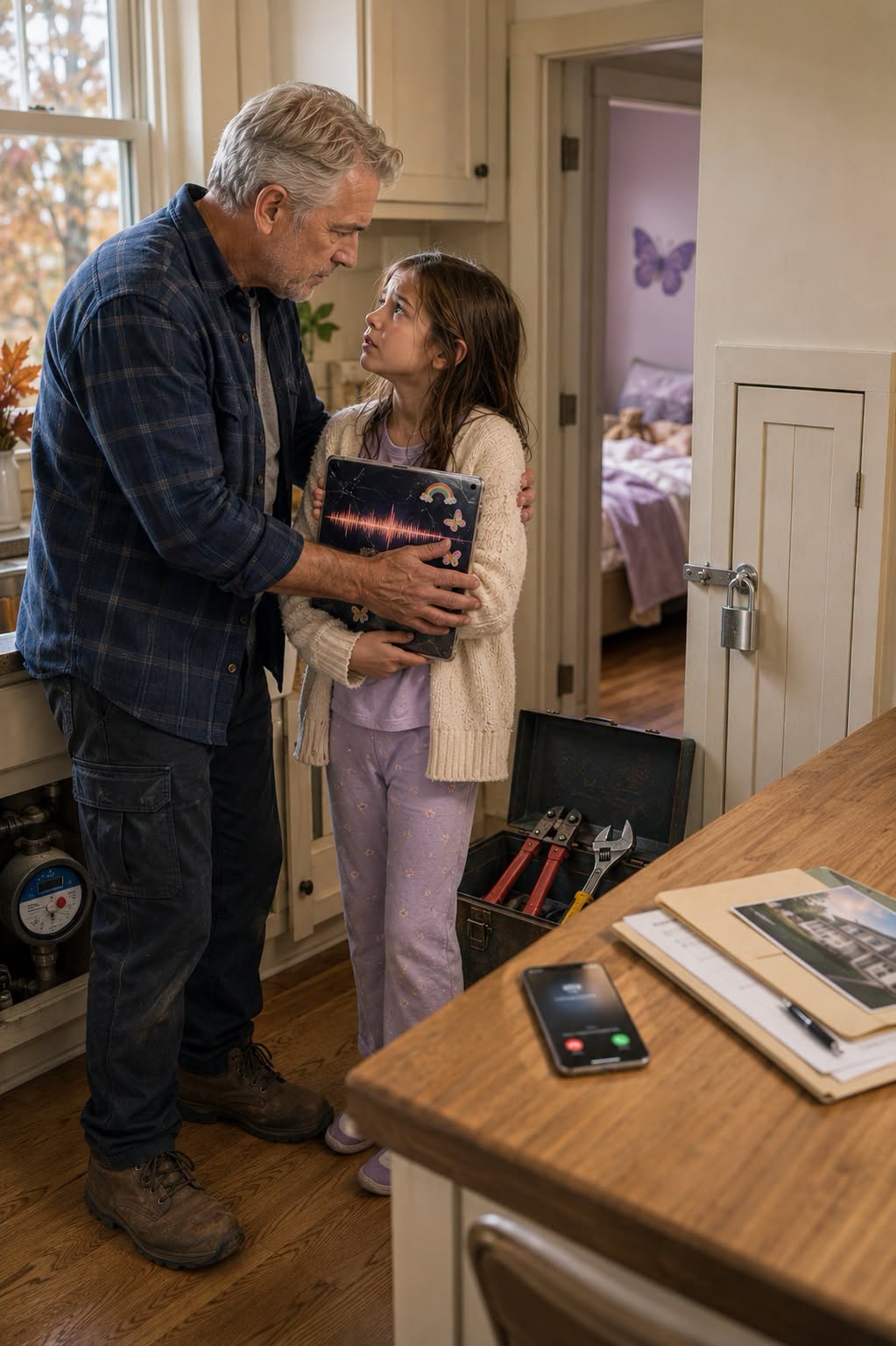
She was wearing pyjamas beneath an oversized sweater. Her hair was tangled. She clutched an old tablet covered with stickers.
She wrapped both arms around my neck.
“I knew you’d come.”
“I’ve got you.”
“Mom said if something really bad happened, I should wait for you.”
My vision blurred.
“You did exactly right.”
She pulled back.
“Is Mom okay?”
“She’s downstairs.”
Gracie pressed the tablet against my chest.
“I recorded things.”
“What things?”
“Dad talking to a woman. I didn’t know what else to do.”
The screen showed a long audio file recorded Wednesday night.
Forty-seven minutes.
I took the tablet.
“That was very smart.”
“I thought you would want to know what happened.”
I carried the tablet under one arm and kept my other arm around Gracie as we walked downstairs.
Clare sat on the steps waiting.
When she saw Gracie, something in her face opened.
“Mom!”
They held each other in the kitchen while I called emergency services.
The dispatcher asked whether both were conscious, whether they could breathe normally, and whether the person responsible was still nearby.
I answered every question.
Then I sat beside my daughter and granddaughter, one arm around each, until help arrived.
Nothing else mattered for those eleven minutes.
Not the house.
Not Brandon.
Not the tablet.
They were alive.
Emergency responders examined Clare and Gracie before taking them to North Ridge Medical Center. Both were exhausted and dehydrated, but neither had a condition the doctors believed would cause permanent physical harm.
I rode in front of the ambulance and called Maggie.
She answered before the first ring finished.
“Ray?”
“I found them.”
Her breath stopped.
“They’re alive. Both of them. We’re going to the hospital.”
The sound she made was not a word. It carried four decades of marriage, motherhood, fear, and relief.
“I’m coming.”
At the hospital, Clare and Gracie were placed in adjoining treatment spaces. A paediatric nurse brought Gracie a red popsicle and a stuffed bear wearing tiny blue scrubs.
She named him Detective Bear.
A county investigator named Samuel Porter arrived while the doctors worked.
He wore a grey sport coat and carried a small notebook. His expression was calm without being distant.
“Mr. Caldwell, tell me what you found.”
I described the newspapers, the car, the water meter, the padlock, the basement, and Gracie beneath the bed.
Then I handed him the tablet.
“Forty-seven minutes of audio.”
“Have you listened?”
“I was busy.”
He took the tablet carefully.
My phone rang.
Brandon.
Porter raised one hand.
“Answer. Put it on speaker.”
I did.
“What did you do?” Brandon demanded. “That is my house. You had no right to enter.”
“Clare is receiving medical care.”
Silence.
“Gracie was hiding under her bed.”
Another silence.
Then Brandon’s voice changed.
“I want to speak with legal counsel.”
He did not ask how his wife felt.
He did not ask whether his daughter was frightened.
He asked about counsel.
“Who is Paul?” I said.
“What?”
“You called me Paul twice.”
“I don’t know what you’re talking about.”
The line ended.
Porter wrote something in his notebook.
“He knows the situation has changed,” he said.
In a private consultation room, he played the tablet recording.
It began with Gracie whispering beneath the bed.
“I’m really scared. Mom said wait for Grandpa Ray, so that’s what I’m doing.”
I pressed one hand against my mouth.
Minutes later, footsteps sounded downstairs.
A woman spoke.
“Brandon, this has gone too far.”
“Tara, calm down.”
“She’s been downstairs since last night.”
“It’s temporary.”
“You said she would sign.”
“She will.”
“And Gracie?”
“She’s supposed to be with my mother.”
“You didn’t check.”
A long silence followed.
Then Brandon said, “The house closes next month. Once the transfer clears, everything becomes simple.”
“What if Clare refuses?”
“She won’t.”
“You keep saying that.”
“She needs more time to understand she has no other option.”
The recording continued.
They discussed a new account, a planned move, and debts Brandon had promised to clear for Tara. He talked about reporting Clare missing after the property transfer was complete, making it appear she had left voluntarily.
Nothing in his voice suggested panic.
This was not a bad decision made in one emotional moment.
It was a plan.
Porter stopped the audio.
“He intended to move her somewhere else within several days,” he said.
“I arrived before that.”
“Yes.”
I looked at the tablet.
Gracie had lain beneath her bed listening to adults discuss her mother as if she were paperwork that needed to disappear.
“She heard all of it.”
“She also preserved it.”
My hands trembled against the table.
Porter lowered his voice.
“Your granddaughter gave us an accurate record. That will matter.”
A text arrived on Maggie’s phone shortly after she reached the hospital.
Unknown number. Tell your husband to stop making this complicated. Clare is safe now. Take your family home.
Porter placed the phone in an evidence sleeve.
“This message is useful,” he told Maggie. “It means someone is reacting. Reacting people make mistakes.”
Maggie’s shoulders straightened.
“What do you need from us?”
Porter asked me to call Brandon again while the line was recorded.
I agreed.
Maggie took both my hands.
“Ray.”
“They left Gracie waiting beneath a bed for five days,” I said quietly. “Whatever he says on a phone call will not be the hardest thing I face today.”
She nodded and released me.
Brandon answered quickly.
“I think we should clear the air,” I said.
“There is nothing to discuss without my attorney.”
“Clare told me about the basement.”
“She’s under stress. She misreads situations.”
“I found the new padlock.”
Silence.
“I also found the water meter running in a house you claimed was empty.”
Nothing.
“And I found Gracie.”
“That was not my responsibility. Clare must have told her to hide.”
“Your mother lives in Savannah. We can call her right now and ask whether she has seen Gracie this week.”
Four seconds of silence.
“I’m not saying anything else.”
“One question.”
“What?”
“Who is Paul?”
His breathing changed.
“You called me that twice. You’ve known me ten years. Who is Paul?”
He ended the call.
Porter looked at the recorder.
“That was not the response of a man confused by the question.”
Seventeen minutes later, Brandon used a credit card at a gas station north of Atlanta.
County officers located him and Tara at a roadside motel that evening.
The next morning, Porter called.
“Both are in custody. Brandon requested counsel and has made no statement. Tara has been speaking for several hours.”
According to Tara, Brandon approached her eight months earlier. He described his marriage as finished and presented himself as a man trapped by financial obligations.
Tara carried significant personal debt.
Brandon promised a new life funded by the sale of the house.
She claimed she did not understand the full plan until shortly before Clare was confined.
She helped him change locks and prepare documents.
Then she heard Clare in the basement and realised the truth was far worse than the story Brandon had sold her.
She still did not leave.
She still did not call anyone.
Regret mattered.
So did choice.
Porter did not soften either fact.
At the hospital, Clare told Maggie and me how the previous two years had changed her life.
“It started small,” she said.
Brandon wanted to know where she went, who she spoke with, and when she would return.
He questioned purchases.
He discouraged visits with friends.
He told Clare that asking us for help would prove she had failed.
“He said you would be disappointed in me for choosing him,” she said. “He said Mom would worry herself sick and it would be my fault.”
Maggie squeezed her hand.
“You believed that?”
“I knew it wasn’t true. Then he repeated it so often that it started sounding like logic.”
Clare had begun keeping a notebook.
Dates.
Missing amounts from the joint account.
Unexplained absences.
Unusual phone calls.
Six months earlier, she found messages from Tara.
After Clare confronted him, Brandon stopped pretending.
He controlled more money, monitored her schedule, and threatened to make any separation difficult.
“I kept waiting for a moment serious enough to justify calling you,” Clare said. “By the time it became obvious, I was already too far inside it to see where normal ended.”
“You never needed to justify calling us,” Maggie whispered.
“I know that now.”
Clare looked at me.
“I didn’t stay silent because I doubted you would come. I knew you would. I stayed silent because I thought asking meant I had failed.”
I thought of homeowners who apologised before calling me about leaks they could not repair.
They waited because they felt embarrassed.
By the time they asked for help, a small drip had become damaged flooring, ruined walls, and mould behind cabinets.
“A pipe under pressure doesn’t fail because it’s weak,” I told her. “It fails because the pressure is too high. That is not the pipe’s fault.”
Her face crumpled.
Maggie leaned forward and held her.
Gracie slept beside them with Detective Bear beneath one arm.
Clare’s friend Linda arrived from Pine Ridge wearing her school lanyard.
She brought photographs of bank statements Clare had shown her months earlier.
Forty-three thousand two hundred dollars had moved from the family account into a company called Foster Holdings.
The transfers appeared in varying amounts, small enough to avoid immediate attention.
Linda also described a man who had visited the school pretending to conduct a district wellness review. He asked whether anyone had reported Clare missing.
Brandon had been checking whether people were looking.
At the county office, Porter spread documents across a clean desk.
Foster Holdings had been registered eight months earlier.
The bank account belonged to Brandon.
A property-transfer document listed Clare’s signature.
A document specialist had confirmed the signature was copied from an old cheque.
The house was scheduled to sell for three hundred eighty thousand dollars. After paying the mortgage, Brandon expected to keep nearly one hundred sixty thousand.
Combined with the transferred funds, he and Tara would have left Georgia with more than two hundred thousand dollars.
The evidence lay in order across the desk.
Bank statements.
Property forms.
Email confirmations.
A closing schedule.
A copy of Clare’s forged signature.
“He planned this for more than a year,” I said.
“Yes.”
“He ate dinner with her. Helped Gracie with homework. Took Sunday calls with us while building this.”
“Yes.”
“Paul?”
Porter nodded.
“Paul Whitfield is his attorney. Brandon had spoken with him repeatedly before you called. That is why he used the wrong name.”
A tiny mistake.
A single name loaded into the wrong place in a frightened mind.
Sometimes a large structure fails because of one small connection.
The property sale was immediately blocked.
The hidden account was frozen.
The forged documents were voided.
Brandon faced serious charges related to coercion, unlawful confinement, financial fraud, and child endangerment. Tara cooperated, but cooperation did not erase her involvement.
The legal process lasted more than a year.
I attended only when Clare asked me to.
The courtroom was not the centre of our recovery.
The centre was Sycamore Court.
Two weeks after leaving the hospital, Clare and Gracie moved into our ranch house.
We converted the spare bedroom into their room.
Gracie chose soft blue paint she called “the inside of a swimming pool.” She insisted on painting the baseboards herself and ended the afternoon with blue marks on her elbow, nose, and jeans.
Every Saturday, Maggie taught her to bake.
Gracie developed strong opinions about the proper ratio of brown sugar to white sugar in peach cobbler. Their negotiations could last twenty minutes.
I sat at the kitchen table listening.
That was what a house was supposed to sound like.
Clare returned to Pine Ridge in January.
Her students made a welcome banner with uneven letters and an unreasonable number of hand-drawn dogs.
That evening, she called me.
“Good day?” I asked.
“Marcus Chen cried when I walked in.”
“He’s nine.”
“He immediately claimed something was in his eye.”
“Smart kid.”
“The smartest.”
She laughed.
The real laugh.
The one I thought we might have lost.
Gracie began counselling and gradually stopped flinching when voices rose in public places. She kept Detective Bear on her pillow and the tablet in a locked desk drawer.
Porter told her the recording had made the evidence far stronger.
She listened seriously.
“I may become a detective,” she said. “Or a marine biologist.”
“Both are respectable.”
Months later, she found me repairing an outdoor faucet in the garage.
“Can I help?”
“Pull up the stool.”
I showed her how to shut off the supply valve before replacing the worn washer.
“That tiny thing caused the whole leak?”
“Tiny problems can create large damage when nobody looks for the source.”
She turned the old washer over in her fingers.
“Is that what happened with Dad? Something inside him wore out, and nobody fixed it?”
I studied her.
“A washer doesn’t choose to leak. Your father made choices. That is different.”
She considered the answer, then handed me the damaged piece.
“Can I install the new one?”
“That’s why I gave you the stool.”
She grinned.
For an instant, she looked exactly like Clare at eight years old beneath my oversized hard hat.
One Sunday evening, months after the missed call, my phone rang at seven.
I sat in my recliner.
Maggie stood in the kitchen holding a dish towel.
Clare and Gracie were only twelve feet away on the couch, watching a movie together.
My phone displayed Clare’s name.
I looked up.
She held her phone toward me, smiling.
“Answer it, Dad.”
I accepted the call.
“Hey, sweetheart.”
“Hey, Dad,” her voice came through the speaker. “Just calling to check in.”
Gracie dissolved into giggles and grabbed for the phone.
Maggie stood in the doorway with tears shining in her eyes.
The Sunday call had returned.
Not from two hours away.
From across the living room.
But it had returned.
For years, I believed being a good father meant stepping back after a daughter became an adult.
Give her privacy.
Trust her choices.
Do not interfere in her marriage.
I still believe adults deserve space.
I no longer confuse space with absence.
There is a difference between respecting someone’s independence and ignoring the silence that replaces their ordinary voice.
I had heard the strain in Clare’s laughter.
I saw the mark near her wrist.
I watched her pull away from friends.
I wanted so badly to avoid becoming an overprotective father that I nearly became an unavailable one.
The missed Sunday call corrected me.
Love does not always mean arriving with answers.
Sometimes it means noticing the unanswered phone.
Calling the school.
Driving the highway.
Reading the newspapers on the walkway.
Trusting a water meter.
Remembering three childhood knocks.
Opening the door.
Brandon had spent months building a plan designed to make Clare disappear quietly from her own life.
He believed isolation would make her easier to control.
He forgot who had taught her that houses talk.
He forgot a child had been promised that Grandpa Ray would come.
And he underestimated the power of a family routine repeated every Sunday for eight years.
The blank screen was not nothing.
It was the loudest message my daughter ever sent me.
I heard it.
And this time, I followed the silence all the way back to its source.