Gaspard and Manon: The Story of Those Who Stay
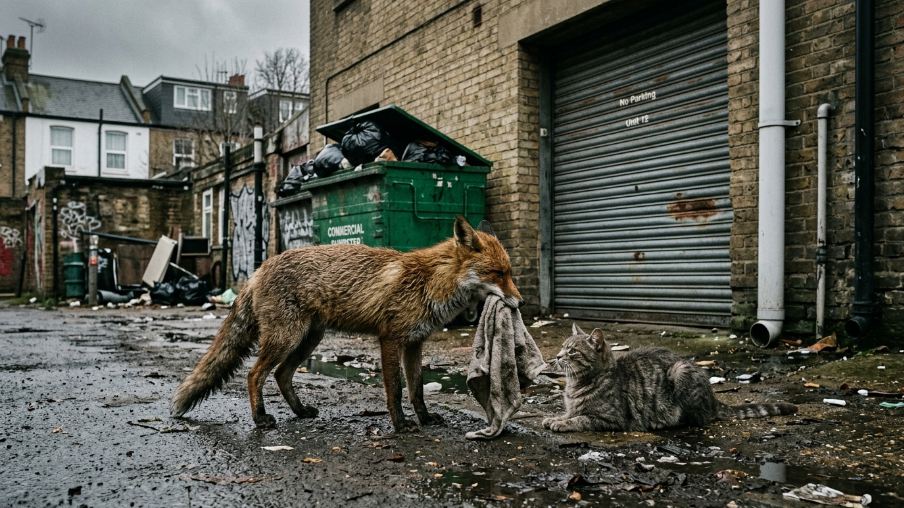
I first thought the fox was waiting for the injured cat to die. Then I saw him pull an old dirty towel towards her.
That was the first time I saw Gaspard.
He was behind a small row of closed shops, on the outskirts of Angers. Thin as a rake, his russet coat dulled by dirt, with a torn ear at the tip. When he breathed, you could see his ribs. His eyes never stayed still.
At first, I had only seen the cat.
She was curled up near a rusty skip, behind an old launderette that had been closed for years. A small grey body. A hind leg folded under her in a way that I did not like at all.
She looked like all those forgotten cats I had picked up in fifteen years of volunteering.
Exhausted. Terrified. As if she no longer expected anything from anyone.
Then the fox placed himself in front of her.
He did not growl. He did not attack. He just stood there, like a little russet guardian, without help, without a plan, with a single message in his gaze:
‘You do not touch her.’
I remember murmuring:
‘Well, I have never seen that before.’
I had already seen strange bonds between animals. Old dogs protecting kittens. A donkey that always slept near a blind goat. But a fox and a cat, behind an abandoned launderette, between a broken vending machine and overflowing bins…
That was something else.
An Observation That Changes Everything
I stepped back slowly and stayed to observe them from my van.
For almost an hour, Gaspard did not leave her. When a car passed through the alley, he placed himself between the wheels and the cat. When she tried to lift her head, he pushed something towards her with his muzzle.
It looked like a piece of crushed chicken, probably retrieved from a discarded tray.
He did not eat first.
He waited.
The cat, whom I later called Manon, smelled it, then took a tiny bite. Only after that did Gaspard lower his head and eat what remained.
At that moment, I felt my throat tighten.
When you have been doing animal rescue for a long time, you learn things that harden the heart a little. People move and leave their animals behind. People grow tired when an animal becomes old, sick, noisy, expensive, or simply inconvenient. Foster homes are full. The phone never stops ringing. Over time, you think you have seen every possible way to abandon a living being.
And then a starving fox lets an injured cat eat before him.
The next morning, I returned with a colleague who often worked with a wildlife care centre. We had a capture cage, blankets, thick gloves, and a tin of cat food that smelled strong enough to attract the whole neighbourhood.
Manon went in first.
The door closed, and the entire alley seemed to explode.
Gaspard began circling the cage. He let out a sharp, hoarse, panicked cry. He threw himself against the wire. Manon, despite her weakness, answered him with meows.
It was not a normal meow.
It was pure fear.
As if she were saying:
‘Do not leave me.’
I stood there, hands trembling.
After another long hour, with great patience, we managed to get Gaspard safely into a second cage. Throughout the journey to the veterinary clinic, they pressed themselves against the metal walls of their cages. Whenever the road was smooth enough, their muzzles almost touched.
Manon’s leg was badly infected, but not broken. She was too thin, dehydrated, covered in old scars. Gaspard was a little better, but not much. He was wild enough to be afraid of us. But not enough to abandon her.
And that was when things became complicated.
A fox is not a pet. An injured cat does not normally stay beside a fox. There were rules, little space, and every week more animals than we could truly accommodate.
So, at first, we separated them.
Manon stopped eating.
Gaspard banged against the door of his enclosure until his muzzle was bruised.
On the second night, I sat on the cold floor, between the two spaces, and wondered why the world always seemed so eager to separate the rare beings who had chosen each other.
Manon slipped a paw between the bars.
Gaspard lay down on the other side and placed his muzzle against it.
I filmed a few seconds.
No music. No pretty caption. No staging.
I posted the video with a single line:
‘They survived together. We are trying not to break them.’
The next morning, my phone would not stop vibrating.
Some people debated, of course. There are always people who debate. But most understood. They saw what I had seen.
Two beings that no one was waiting for. Two animals who had become a family in a place where no one should have been living.
A Home for Two
A week later, a woman named Claire called me. She lived on a small farm outside the city. She already had experience with difficult animals, a secure outdoor enclosure, a heated shelter, and the habit of working with people trained in wildlife care.
She said simply:
‘I do not want the cat without the fox. And I do not want the fox without the cat.’
That was the first time I cried.
Three months later, I went to visit them.
Manon still limped, but she walked. Her grey coat had become soft. She was lying on a thick blanket near the small doorstep, her eyes half-closed, like an old lady who had finally earned a quiet afternoon.
Gaspard rested a few metres away, under a tree at the back of the enclosure. He was still watching everything. Every bird. Every car. Every one of my movements.
But when a cool breeze swept across the yard, he stood up, walked over to Manon, and lay down beside her.
Then he curved his thin russet body around her, just as he had done behind that old launderette.
Manon did not even open her eyes.
She just leaned against him.
I had spent years finding homes for animals. That day, I understood that I had perhaps been viewing the word home too narrowly.
A home is not always a house. It is not always the same name, the same blood, or the same species.
Sometimes, a home is a starving fox watching over an injured cat.
And sometimes, family is simply the one who stays close to you in the cold, long after the rest of the world has already passed by without stopping.
What I Learned from Them
I thought the story of Gaspard and Manon had ended the day I saw them sleeping together, finally warm. But three months later, Claire called me with a sentence that took my breath away.
‘There is something you need to see.’
On the phone, her voice was not worried. It was moved.
And sometimes, when you work with injured animals, a moved voice is more frightening than a panicked one. Because you never know whether you are about to receive good news… or the kind of news that stays in your chest all day.
I asked her if Manon was doing well.
Claire breathed out softly. ‘Yes. She is doing well. That is exactly it. Come when you can.’
I left the next morning.
The road to the small farm was the same as last time. Low fields, hedges, old houses with slightly faded shutters, and that particular calm of the countryside around Angers when the day is just beginning.
I had brought a bag of special food for Manon, a few clean blankets, and an old grey towel.
Not just any towel.
A dirty, worn, almost ridiculous towel, found behind the old launderette on the day of the rescue.
I had washed it, of course. But I had never managed to throw it away.
I did not know why.
Perhaps because, sometimes, objects keep a small part of the stories they have passed through.
Claire was waiting for me at the gate.
She wore heavy boots, an old wool gilet, and that tired smile of people who care for animals before thinking of themselves.
‘Do not make any noise right away,’ she said.
We walked to the enclosure.
The morning was fresh. The grass was wet. A hen was crying out somewhere behind the barn, as if she had discovered a personal catastrophe.
And then I saw them.
Manon was on the small doorstep, sitting upright.
Not lying down. Sitting.
Her hind leg was still trembling a little, but she held. She was looking at the yard with an almost peaceful expression, as if the world belonged to her a little again.
Gaspard was beside her.
Not pressed against her, not nervous. Just there.
He still had his torn ear, his russet coat still irregular in places, and that gaze that checked everything. But he no longer looked like an animal waiting for danger at every second.
He looked like an animal who had understood that here, no one was going to take the one he protected.
I felt my eyes sting.
‘Look closely,’ Claire whispered.
Manon took a step.
Then a second.
Slowly.
She came down from the doorstep, crossed three metres of wet grass, then stopped near a small water bowl.
Gaspard did not move.
He let her do it.
Before, he always placed himself between her and the rest of the world. In front of a car, in front of a cage, in front of a human hand, in front of a door.
That morning, he had stayed behind.
As if, for the first time, he was telling her:
‘You can go. I am watching.’
Manon drank.
Then she turned back to him.
She meowed once.
A small cracked sound, not very pretty, but full of life.
Gaspard stood up and joined her.
Claire wiped her face with her sleeve.
‘Do you understand now why I called you?’
I understood.
Manon was no longer merely surviving.
She was beginning to live again.
And Gaspard was learning something even more difficult.
He was learning that loving someone is not always about placing yourself in front of them.
Sometimes, it is staying close enough that they dare to move forward alone.
We remained silent for a long time.
There are moments that should not be spoiled with too many words.
After a while, Claire led me to the small heated shelter at the back of the enclosure. Inside, everything was simple. A low kennel, blankets, a wooden crate, two bowls, and an old cushion that Manon had clearly chosen as her personal throne.
On the wall, Claire had hung a small wooden board.
Not decoration. Just two printed photographs.
The first came from my video. Manon, thin and grey, her paw slipped between the bars. Gaspard, muzzle pressed against her.
The second was from the previous week. Manon curled up on a blanket. Gaspard beside her, asleep, his tail wrapped around her.
Same position. Same tenderness. But not the same world around them.
I stood in front of those two images longer than expected.
Claire said:
‘I look at them on days when I am tired. They remind me why we continue.’
I knew exactly what she meant.
There are days when you feel like you are emptying the ocean with a spoon.
A call for a cat abandoned in a flat. An old dog that no one wants anymore. Kittens found too late. Full cages, exhausted foster families, messages you do not always have the strength to answer.
And then, in the middle of all that, there is a fox pulling a towel towards an injured cat.
A tiny detail. A light.
Enough to start again the next day.
Claire made me coffee in her small kitchen.
A kitchen like you still find in old country houses. A wooden table marked by the years, a checked tablecloth, tea towels drying near the sink, and the smell of toast.
Through the window, you could see the enclosure.
Manon was back on the doorstep.
Gaspard had disappeared under his favourite tree.
‘He will never really be tame,’ Claire said.
‘I know.’
‘But he is not lost anymore either.’
That sentence touched me more than I would have expected.
Because it was true.
Gaspard was not a cat. He was not a dog. He was not an animal you stroke to reassure yourself.
He kept his distance, his wariness, his wild side. He did not come looking for hands, he did not ask for anything, he did not pretend to be anything other than what he was.
But when Claire arrived with the bowls, he no longer fled to the back of the enclosure.
He stepped back two paces.
Only two.
And for him, that was enormous.
Manon, for her part, had changed in another way.
She had started seeking out Claire’s knees.
Not all the time. Not with everyone.
But in the evening, when the yard turned blue and the house grew quiet, she sometimes came near the bench, placed a paw on Claire’s boot, then climbed up slowly.
The first time, Claire had not dared to breathe.
Manon had settled on her as if she had always lived there.
Gaspard had stayed at the foot of the bench.
He watched. Not jealous. Not worried. Just present.
Claire told me this while looking down at her cup.
‘I have had many animals in my life. Bruised ones, difficult ones, old ones, frightened ones. But these two… they changed me.’
I did not ask how. I could see it.
In the way she spoke more slowly. In the way she did not try to possess their story. In the way she said ‘they live here’ rather than ‘they are mine’.
Later, we went back outside.
I still had the old grey towel in my bag.
I felt a little silly with it.
Claire smiled when I showed her.
‘You kept it?’
‘Yes. I am not really sure why.’
She took it in her hands.
Gaspard was already watching us from the back of the enclosure.
His ears moved. His body had tensed.
Claire placed the towel near the doorstep, without any sudden movement, and we stepped back.
Manon smelled it first.
She put her nose on it for a long time.
Then she looked up at Gaspard.
The fox approached very slowly.
One step. Then another.
He smelled the towel.
And then, something happened.
Nothing spectacular. Not a big moment like in the films.
He simply grabbed a corner of the fabric between his teeth.
Then he pulled it gently towards Manon.
Exactly like the first time.
Behind the launderette. Near the rusty skip. In the cold.
Except this time, Manon was no longer lying on the concrete.
She was standing.
And this time, Gaspard was not pulling a dirty towel because he had nothing else to offer. He was pulling a memory towards her.
Claire brought a hand to her mouth.
I did not even try to hold back my tears.
Manon sat down on the towel.
As if she understood. As if she accepted that part of their old life was there, under her paws, but that it no longer imprisoned them.
Gaspard lay down beside her.
Not around her. Beside her.
Manon leaned over and rubbed her head against his russet shoulder.
He closed his eyes for a second. Just one.
But I saw it.
And I think I will never forget it.
After that visit, I returned home with a strange peace.
The video of Gaspard and Manon continued to circulate a little. People sent messages, asked for news, told their own stories.
A woman wrote that she had adopted two old cats together because she had thought of them.
A man sent me a photo of a sick dog that no one wanted and that he had finally kept.
A mother told me that her daughter, after seeing Manon walk, had insisted on helping a local association the following Saturday.
I do not know what grand statements on the Internet are worth.
I am often wary of them.
But I know how to recognise when a small story moves something in people.
Even just a little.
And sometimes, just a little is enough.
Winter came gently.
Claire sent me news from time to time.
Not too often. Just enough for me to know.
Manon slept a lot near the heater in the shelter.
Gaspard had discovered that he liked pieces of apple, but only when no one was looking directly at him.
Manon had taken to stealing the thickest blanket.
Gaspard let her.
Once, Claire wrote to me:
‘It is snowing a little. They both went out.’
The photo showed the white yard, the pale sky, and two silhouettes near the small tree.
The grey cat, rounder than before. The russet fox, still thin, but solid.
They were looking in the same direction.
I stayed in front of that image for a long time.
Because it said something I could not have formulated otherwise.
They had not had an easy life.
They had not received the world with gentleness.
They had known hunger, pain, fear, alleys where people pass without stopping.
But they had not become hard towards each other.
They had kept that rare thing.
The ability to stay.
In spring, Claire organised a small open day for a few trusted people. Not a party. Not a show.
Just a quiet afternoon to show her work, explain the needs of difficult animals, and thank those who had helped without seeking the spotlight.
Gaspard and Manon were not presented as an attraction.
Claire had been very clear about that.
They would be observed from a distance, if they wanted to be seen.
Otherwise, they would be left alone.
I was there to help serve coffee and answer simple questions.
A little girl of about eight arrived with her grandmother.
She had a folded drawing in her hands.
On the drawing, you could see an orange fox and a grey cat under a big yellow sun.
Underneath, she had written in crooked letters:
‘For those who stay.’
The grandmother explained that the little girl had watched the video several times.
She had asked why the fox did not leave.
Her grandmother had answered:
‘Because he loves her in his own way.’
The little girl had thought about it.
Then she had said:
‘Then I want to learn to stay kind even when I am afraid.’
I did not know what to reply.
There are children’s sentences that are worth more than all the speeches of adults.
At the end of the afternoon, when the visitors had left, Claire hung the drawing in the shelter, next to the two photographs.
Manon came to smell it.
Then she climbed onto the cushion.
Gaspard stayed outside for a few minutes, as usual.
The sun was setting behind the hedges.
The yard took on that golden colour you only notice when you are not in a hurry.
Then he came in.
He looked at the drawing.
He looked at Manon.
And he lay down beside her.
This time, there was no more alley. No more skip. No more cage. No more panicked cry in a van.
There was only a warm shelter, a cat breathing calmly, a fox still watching, and an old towel folded in a corner.
I left before nightfall.
On the way back, I thought back to the first time I had seen them.
Me, in my van. Them, behind that abandoned launderette.
Me, thinking the fox was waiting for the cat to die.
When in reality, he was doing what so many people forget to do.
He was accompanying someone through their worst moment.
Without noise. Without promise. Without asking for anything.
Today, Manon still limps a little.
Gaspard still does not let himself be touched.
They have not become perfect animals for a pretty story.
They are better than that.
They have become themselves, but in safety.
And that is perhaps the most beautiful ending one could wish for a wounded being.
Not to become something else. Not to forget all that hurt.
But to find a place where you no longer need to survive every minute.
A place where you can sleep. Eat. Breathe. Grow old gently.
With someone who recognises you.
A few weeks after my last visit, Claire sent me a short video.
It showed Manon lying on the old grey towel.
Gaspard was beside her, his muzzle resting on his front paws.
It was snowing lightly outside.
You could only hear the wind, and the small steady sound of their breathing.
Then Manon opened her eyes.
She looked at Gaspard.
She placed her paw on his neck.
And he, the thin fox with the torn ear, the one who had kept watch behind an abandoned launderette when everyone passed without seeing, did not move.
He stayed.
Again.
So I understood that some stories do not really end.
They simply become quieter. Less visible. Less noisy.
But they continue somewhere, in a quiet yard, between a warm blanket, a clean water bowl, and two animals who were never meant to meet.
I often thought that rescuing an animal meant giving it a roof.
Then Gaspard and Manon taught me something else.
Rescuing, sometimes, is refusing to break the only bond that allowed two beings to hold on until then.
It is accepting that family does not always look like what you expect.
It is understanding that a home can have four walls, yes.
But that it can also begin with an old dirty towel, pulled gently across cold concrete.
And with someone who decides, in the midst of abandonment, not to leave.